
This is a very delicate question, because some people like to believe that "when you want, you can". This is wrong, at least, in the field of endurance racing. Not everyone, even with all the willpower in the world, has the ability to run a marathon below 2:05. Even the ability to improve is not equal.
We have to face the facts, even with perfect “technique”, “perfect” training and perfect conditions, most of us wouldn't even approach these times. Why is that? Is it a question of morphology (largely determined genetically) or are there other factors that make everyone not improve equally?
Genetics are an important factor
A study published in 1984 carried out on monozygotic twins states that there are large inter-individual differences between individuals' capacities to adapt to training. On the other hand, this ability to respond to training is largely dependent on the genotype.
But how much does the response to training depend on genetics?
The HERITAGE study was piloted at Laval University and answered several questions in the area of the association between genetics and physical activity. As part of this study, they evaluated 481 individuals from 98 families. The subjects were all related by family relationship (parents-children only). The subjects were sedentary and underwent a 20 week training protocol.
Here are two interesting graphics:
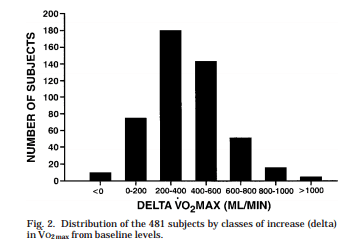
In this graph, we see that the improvement of individuals in training is a bell-shaped curve. Most people have an increase in their Vo2Max between 200ml and 600ml per minute. Note that VO2Max is often expressed in ml per kg per minute, whereas in this study, VO2 max is measured in ml per minute.
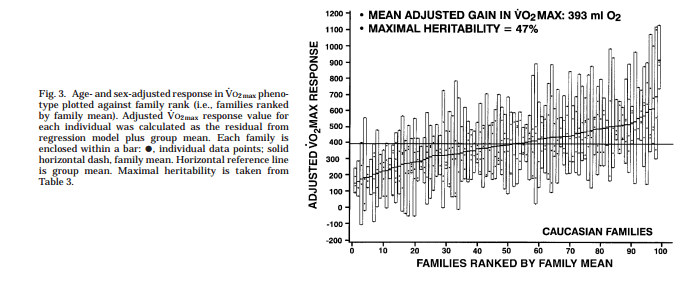
In this graph, the vertical bars group together all the results within the same family. We quickly notice that the response of VO2 Max to training varies much more between families than within families.
At the end of the training period, there was 2,5 times more variance in training response between families than within families. The Heritability of the VO2 max response to training is estimated to be around 47%. This means that when you run, your level of improvement is determined by your genetics at 47%… Of this 47%, 28% would be attributable to the genetic material of the mother, while 19% would come from the father.
Do you find it a lot? Little?


Is the% of genetic material the same for a man and a woman. Knowing that the man only receives an X from his mother and the Y from his father?
I find that a lot, I would like there to be less genetic influence and more personal influence, but it's not us who decide! 😉
I read somewhere that the capacity for improvement is at its best during adolescence, that genetics could then have a little less influence or that we would have a little influence on genetics during this period. .
Another thought that brings me. Do we have an influence on our genetics. If I push the machine and go beyond my limits before having children, will I bequeath more efficient genes and hope to change a genetic inheritance after a few generations? (We talk 😉).
Yet another interesting article!
Have a good day!
It's a shame, but it is indeed a lot. Here, the study is on the improvement that people get after training. We are not talking about their basic level (next article). Indeed, if a teenager is athletic, he develops adaptations that will stay with him throughout his life.
Regarding your thinking. We have no influence on our genetics. Genetics vary on their own from generation to generation, but you have no influence on your DNA. On the other hand, by placing your children in an environment favorable to physical activity you maximize its non-genetic factors ...
We do however have a small influence via epigenetics.
I don't know too much about epigenetics, could you elaborate on your point of view?
In a very summary version, our lifestyle (exercise, diet) can have an effect on our DNA (modulated inhibitions of the transcription of certain genes, for example, the genes responsible for the synthesis of endogenous lipids, if we are interested in metabolism); these changes can become transmissible to daughter cells when our cells divide, this is called epigenetics. A kind of inheritance between our own cells, influenced by different factors, different from the inheritance between parents and children (although it is undoubtedly possible that these genetic peculiarities are transmitted to the child, I do not know too much).
Were the twins raised together? If so, this greatly reduces the interest of the study since confounding factors (such as the amount of sport done younger, the motivation imposed by the environment, etc.) may have played a role.
Hi, in the first study, yes the twins are raised together. Except that this does not modify the results of the 2nd study and above all, the environment has less importance on the response to training than on the general level of fitness. It is true that the ideal would have been to evaluate twins not raised together on the other hand or even to have a little of each.
The second study is a little better. On the other hand, I am a scientist and despite the fact that I believe in genetics as an explanatory factor in this case (we all have our biases), the study does not convince me. Reading the recent studies on the heritability of IQ will give you almost endless leads on all the weaknesses of these 2 studies. The debate is much more manly in the field of intelligence since it seems to touch the egos more (say!) And the debates always improve the quality of research.
I very much appreciate your point of view and I also appreciate that you doubt studies. When we agree with a study, we tend to be convinced more easily.
Having said that, it seems to me that it is easier for me to conceive that the heritability of VO2Max is greater than that of IQ, since we see that different people have bodies that are different. However, this is only an impression and it could indeed be the opposite ...
No. There is no real reason to believe that VO2Max is more 'heritable' than IQ. A not-so-recent study, for example, showed a moderate to strong correlation (.71; therefore approx 50% of variance explained) between IQ measured by tests and a measurement of the speed of electrical conduction of a nerve. the forearm. It seems to suggest that when you are well built (physically speaking) you are more brilliant.